
Kenya’s home internet market is entering a recalibration phase where speed upgrades are being used as a competitive tool rather than price cuts, with Safaricom restructuring its Home Fibre portfolio by raising speeds across all major tiers while keeping monthly charges unchanged in a bid to protect its dominance in a segment where rivals are aggressively competing on affordability and value per megabit.
The new structure raises entry level Home Fibre speeds to 40 Mbps from 15 Mbps, lifts mid tier packages from 30 Mbps to 60 Mbps and from 80 Mbps to 150 Mbps, while retaining pricing at Ksh 3,000, Ksh 4,100, and Ksh 6,300, with premium tiers of 500 Mbps and 1 Gbps maintained at Ksh 12,500 and Ksh 20,000 respectively, effectively increasing delivered bandwidth per shilling without altering tariff levels.
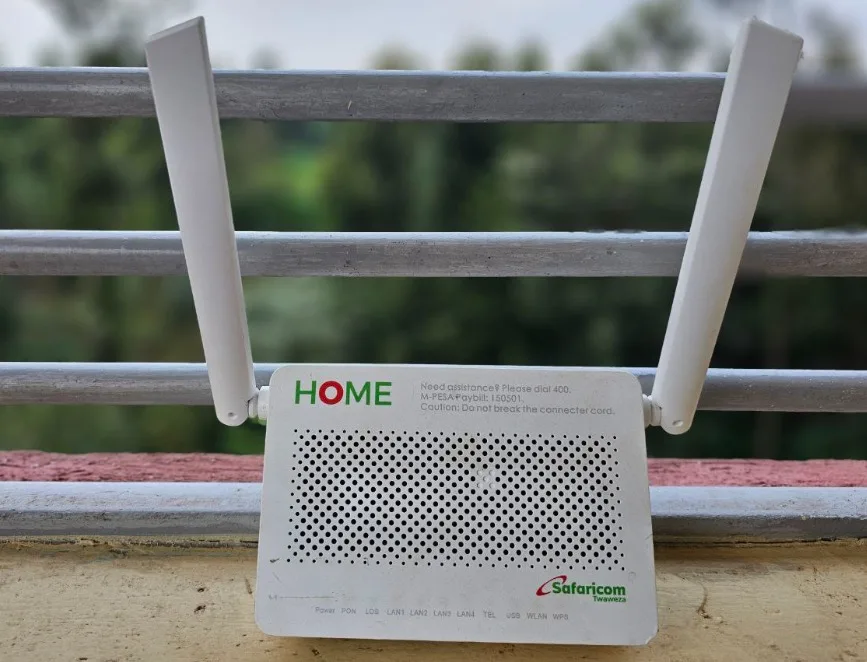
The shift comes at a time when Safaricom holds 34.9% of Kenya’s fixed internet subscriptions according to Communications Authority data, followed by Jamii Telecommunications at 20.1% and Wananchi Group at 11.1%, while a combined 34% of the market is served by smaller providers such as Poa Internet, Ahadi Wireless, and Vilicom, reflecting a fragmented lower tier segment where price competition is most intense.
Airtel Kenya has positioned itself aggressively in that segment with 15 Mbps priced at Ksh 2,000 and 100 Mbps at Ksh 5,000, while newer entrants such as Savanna Fibre have pushed pricing further down the scale by offering 100 Mbps at Ksh 2,000, creating a pricing environment where cost per Mbps has become a primary comparison metric for households rather than headline subscription fees.
Safaricom’s previous 15 Mbps entry plan at Ksh 3,000 had come under pressure in that environment, particularly in households with multiple connected devices where performance constraints become more visible, creating a perception gap when compared to higher speed offers at similar or lower price points from competitors operating with leaner infrastructure footprints.
The revised structure shifts that entry point to 40 Mbps, a level that materially changes usage capacity for streaming, video conferencing, and multi device household connectivity, reducing the immediate incentive for entry level customers to migrate to rival networks purely on speed grounds.
Mid tier restructuring follows a similar logic, with 60 Mbps and 150 Mbps now positioned closer to competing mid market offers where most residential subscriptions are concentrated, a segment that has become the primary battleground for fixed internet providers due to its scale and predictable revenue base.
Top end packages at 500 Mbps and 1 Gbps remain unchanged, reflecting limited mass adoption of ultra high capacity plans in the Kenyan household segment, where demand is still largely concentrated between entry level and mid tier bandwidth ranges rather than enterprise grade connectivity.
The adjustment also reduces effective cost per Mbps across Safaricom’s most widely subscribed packages without changing tariff structures, a move that allows the operator to defend revenue stability while responding to competitive pricing pressure without triggering a direct price reduction cycle across the market.
The broader implication of the shift is a repositioning of competition from tariff comparison to performance expectation, where advertised speeds set a benchmark for perceived service quality, particularly during peak usage hours when network consistency becomes a key determinant of customer retention.
Safaricom Chief Executive Peter Ndegwa framed the upgrade as part of a broader shift in household connectivity needs.
“Customers to enjoy faster internet at no extra cost across all plans,” said Peter Ndegwa, Chief Executive Officer, Safaricom.
“As homes become increasingly connected, reliable high speed internet is no longer a luxury but an essential service for modern living. By upgrading Home Fibre speeds, we are delivering greater value to our customers, strengthening our market leadership, and laying the foundation for smarter, more connected homes and communities across Kenya. Customer expectations continue to rise, and we are committed to meeting them while maintaining a competitive edge. With this upgrade, we aim to provide smooth multi device streaming, buffer free video calls, and reliable performance,” said Peter Ndegwa, Chief Executive Officer, Safaricom.
Safaricom’s Home Fibre footprint now extends to more than 800,000 households nationwide, positioning the operator at the centre of Kenya’s fixed broadband expansion at a time when demand for home based connectivity continues to rise in line with remote work adoption, digital entertainment consumption, and cloud based service usage.
In the revised structure, Safaricom’s product ladder now spans entry level packages such as Wi Fi Bamba and Fibre Lite tiers through to Bronze, Silver, Gold, Ruby, Diamond, and Platinum offerings, with speeds ranging from 15 Mbps at the lower end to 1 Gbps at the top end, reflecting a tiered approach designed to segment households by usage intensity rather than uniform pricing.
| Package | Old Speed | New Speed | Price (Ksh) |
|---|---|---|---|
| Wi Fi Bamba 6 Mbps | 6 Mbps | 15 Mbps | 1,600 |
| Wi Fi Bamba 10 Mbps | 10 Mbps | 20 Mbps | 2,000 |
| Fibre Lite 5 Mbps | 5 Mbps | 15 Mbps | 1,500 |
| Fibre Lite 7 Mbps | 7 Mbps | 20 Mbps | 2,000 |
| Bronze | 15 Mbps | 40 Mbps | 2,999 |
| Silver | 30 Mbps | 60 Mbps | 4,100 |
| Gold | 80 Mbps | 150 Mbps | 6,299 |
| Ruby | N/A | 300 Mbps | 9,999 |
| Diamond | 500 Mbps | 500 Mbps | 12,499 |
| Platinum | 1000 Mbps | 1000 Mbps | 20,000 |