
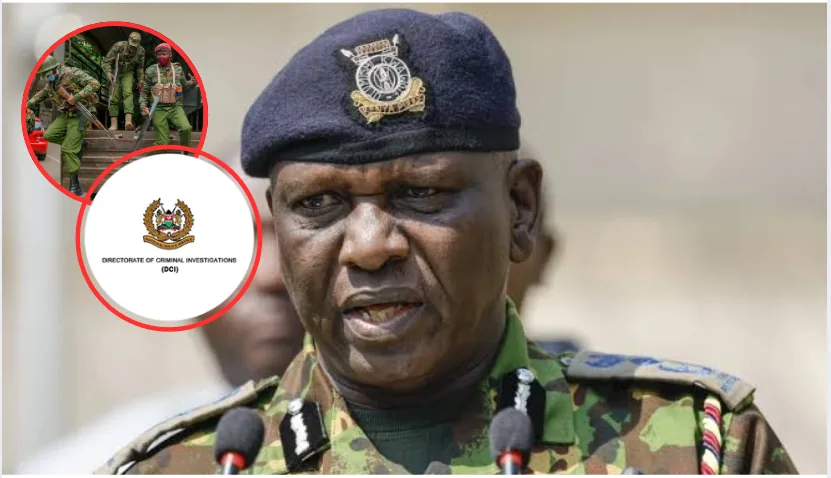
Inspector-General of Police Douglas Kanja has introduced major changes to the National Police Service (NPS) Standing Orders, giving him expanded powers to reorganise police formations, units and command structures across the country.
The changes were published in a special issue of the Kenya Gazette on July 30 and replace the existing Chapter Seven of the National Police Service Standing Orders with a new framework that governs the structure and operations of the Kenya Police Service (KPS), Administration Police Service (APS) and the Directorate of Criminal Investigations (DCI).
Under the revised rules, the Inspector-General is authorised to establish, merge or abolish police formations, units and components, provided the decisions are approved and issued in writing.
The new framework also requires the IG to provide written directions in cases where disputes arise over the roles and responsibilities of different police formations, units or investigative commands. The move is aimed at improving coordination and reducing overlaps within the service.
Additionally, all operational guidelines and standard operating procedures for police formations, units, bureaus, investigative commands and other NPS components must receive approval from the Inspector-General.
The Kenya Police Service, currently headed by Deputy Inspector-General Eliud Lagat, will operate through several specialised units under the new structure. These include the General Service Unit (GSU), Kenya Police Traffic Unit, Presidential Escort Unit (PEU), Kenya Airports Police Unit (KAPU), Kenya Railways and Ports Police Unit, K9 Police Unit, Nairobi Metropolitan Police, Diplomatic Police Unit, Tourist Police Unit, Marine Police Unit, Quick Response Unit and Government Vehicle Check Unit.
The Administration Police Service, led by Deputy Inspector-General Gilbert Masengeli, will continue operating through specialised formations including the Border Police Unit (BPU), Anti-Stock Theft Police Unit (ASTU) and Critical Infrastructure Police Unit (CIPU).
Other APS formations under the new framework will include the Judiciary Police Unit, Energy Police Unit, Mining Police Unit, Water Police Unit and the National Government Administration Police Unit.
The Directorate of Criminal Investigations, headed by Director General Amin Mohamed, will also undergo restructuring with new and expanded investigative formations.
The DCI structure will include the Counter-Terrorism Bureau, National Anti-Narcotics Investigations Bureau, Crime Research and Intelligence Bureau, NPS Forensic Laboratory, Kenya Airports Criminal Investigations and Kenya Railways and Ports Criminal Investigations.
The new rules also grant the DCI authority, in consultation with the Inspector-General, to establish command structures, determine the deployment of investigative formations and reorganise specialised units, sub-units, sections and desks to improve efficiency.
The amendments further place police training institutions under a unified National Police Service training system, requiring all formations to operate in line with approved policies, operational guidelines and standard operating procedures.
The government says the reforms are designed to strengthen coordination, clarify command responsibilities and improve the overall management of police operations across the country.