
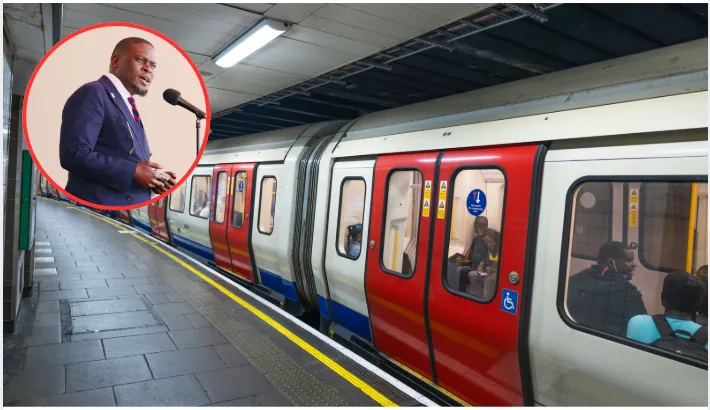
Nairobi’s planned underground railway system is expected to cost more than Ksh1 trillion for its first phase, Nairobi Governor Johnson Sakaja has revealed.
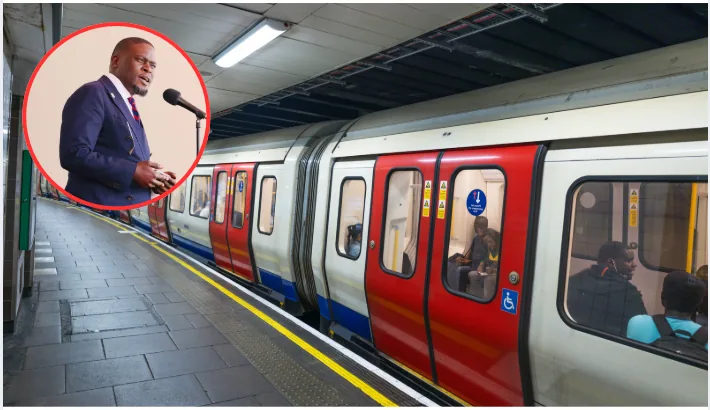
The proposed Nairobi Mass Rapid Transit System (NMRTS), which will run beneath the Central Business District (CBD) and connect to Eastlands, has received Cabinet approval as the city seeks a long-term solution to rising traffic congestion.
Speaking before the Senate National Security Committee on Thursday, July 23, Sakaja said the first phase of the project will require approximately USD7.78 billion, equivalent to more than Ksh1 trillion.
“I will be very happy to share with you what is so clear on phase one of what we need. It is USD7.78 billion (Ksh1 trillion). But the USD7.78 billion has been broken down into different components of financing,” Sakaja told the committee.
The Governor explained that the project will be financed through a combination of government funding, pension funds and transport-oriented development initiatives.
He said the national government is expected to contribute at least USD3 billion, approximately Ksh388 billion, while other financing will come through mechanisms such as land value capture, where increased land value along transport corridors helps support infrastructure development.
“Some is coming from the pension funds. Some will come from transport-oriented development because of land value capture. Some of it will come from government, at least USD3 billion (Ksh388 billion),” Sakaja stated.
The announcement comes a day after the Nairobi County Cabinet approved plans for the underground railway project, which would become the first railway system of its kind to be constructed in Kenya.
The initial phase will include an underground rail core passing through the CBD and the Eastlands Line, connecting major commuter routes within the capital.
“By integrating an underground CBD core with high-capacity links to Eastlands, we will unlock Nairobi’s economic potential, lower the cost of transport and build a cleaner, greener and world-class city,” Sakaja said.
The Governor noted that proposals for a metro system in Nairobi date back decades, with early plans emerging in 1948 when city planners suggested a ring railway and CBD rail connections.
Similar proposals were later included in the 1972 Nairobi Metropolitan Growth Strategy and the 2014 Nairobi Integrated Urban Development Plan, but they were never implemented.
Sakaja said a dedicated project management unit will be created to supervise the implementation of the railway system, adding that previous feasibility studies conducted with support from international partners, including the Japan International Cooperation Agency (JICA), will guide the project.
He further stated that Nairobi’s underground conditions are favourable for tunnelling, arguing that the city has fewer underground infrastructure challenges compared to older global cities.
The Governor pointed to the underground crossing at Haile Selassie Avenue and Uhuru Highway as evidence that Nairobi has the capacity to undertake major underground infrastructure projects.
The proposed metro system will also be integrated with other transport solutions, including Bus Rapid Transit (BRT) networks and non-motorised transport systems, as part of efforts to create a more efficient and sustainable urban transport network.