
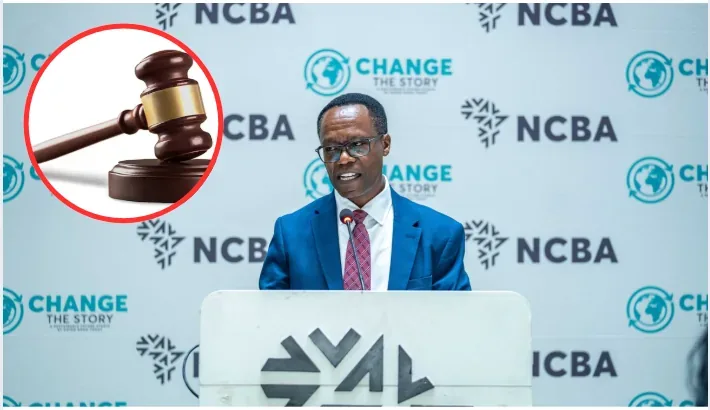
NCBA Group Managing Director and CEO John Gachora has secured temporary protection from the High Court, stopping his arrest and prosecution over allegations arising from a Sh363 million fraud case involving First Assurance Investment Company Limited.
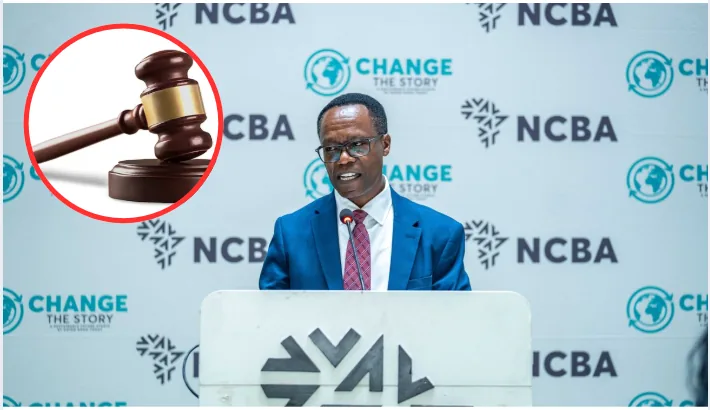
Justice Gregory Mutai issued the orders ahead of Gachora's scheduled plea, temporarily restraining the Director of Public Prosecutions and other state agencies from arresting, charging or compelling the NCBA chief executive to appear before the trial court.
The ruling gives Gachora crucial breathing room, but it does not amount to an acquittal or establish that the allegations against him are false.
Instead, the High Court will first examine his legal challenge before determining whether the intended criminal proceedings can proceed.
Gachora Not Accused of Stealing Sh363 Million
A crucial distinction lies at the centre of the case.
Gachora is not accused of personally stealing the Sh363 million allegedly lost by First Assurance Investment Company.
Prosecutors instead accuse him of failing to ensure that suspicious transactions connected to the alleged fraud were reported as required under Kenya's anti-money laundering laws.
The allegations are tied to obligations imposed on financial institutions under the Proceeds of Crime and Anti-Money Laundering Act (POCAMLA).
The prosecution's case is that suspicious transactions involving accounts at three banks should have been reported to the relevant authorities.
The three banking executives remain presumed innocent. Prosecutors will ultimately have to prove both that the alleged reporting failures occurred and that the individual executives can legally be held criminally responsible for them.
Sh363 Million Allegedly Stolen Over Six Years
The underlying investigation concerns the alleged theft of approximately Sh363 million from First Assurance Investment Company Limited between May 2018 and April 2024.
Former nominated MCA Salim Mohamed Busaidy has been identified as the principal suspect in the alleged fraud.
Busaidy was reportedly a director of the company alongside Lamu Governor Issa Abdalla Issa.
According to the prosecution, Busaidy allegedly forged the governor's signature on company cheques before using them to withdraw money from accounts held at NCBA.
He is also accused of using part of the allegedly stolen funds to acquire assets.
Busaidy faces 120 charges, including conspiracy to defraud, stealing and acquiring proceeds of crime. He has pleaded not guilty.
Why Are Three Bank CEOs Facing Prosecution?
The involvement of three prominent banking executives has transformed the matter into a major test of banking accountability in Kenya.
The allegations against Gachora are fundamentally different from those facing Busaidy.
Prosecutors are not alleging that the NCBA boss forged cheques, stole First Assurance's money or personally received the Sh363 million.
Instead, the case centres on whether suspicious transactions were properly detected and reported and, more importantly, whether chief executives can personally face criminal liability for alleged failures within their institutions.
That distinction is likely to become one of the most fiercely contested issues in the case.
Banks process enormous volumes of transactions and typically have dedicated compliance departments responsible for monitoring unusual activity.
Prosecutors will therefore have to establish more than the alleged absence of suspicious transaction reports. They will also need to demonstrate the legal basis for holding individual chief executives criminally responsible.
Six Years of Transactions Raise Bigger Questions
The length of time covered by the alleged fraud is another major issue.
The suspected theft is said to have occurred between May 2018 and April 2024, almost six years.
If prosecutors establish that hundreds of millions of shillings were improperly withdrawn during that period, serious questions will arise about whether banking controls detected unusual activity.
Were the transactions flagged?
Did compliance teams investigate them?
Were suspicious transaction reports filed?
If reports were submitted, when were they made and what action followed?
If they were not filed, why?
And at what stage, if any, did senior management become aware of the transactions?
These questions extend beyond the three executives.
They go directly to the effectiveness of anti-money laundering controls within some of Kenya's largest financial institutions.
Gachora Takes Fight to High Court
With his plea approaching, Gachora turned to the High Court seeking protection from the intended criminal proceedings.
Justice Mutai subsequently issued orders stopping the authorities from arresting, charging or compelling him to take plea while his legal challenge is being considered.
The intervention has temporarily put the prosecution against the NCBA boss on hold.
But it has not killed the case.
The High Court must still determine the merits of Gachora's challenge and whether prosecutors acted within the law when seeking to charge him.
If his challenge succeeds, the prosecution against him could potentially be halted.
If it fails, the criminal proceedings could resume, subject to any further orders or appeals.
The Court Order Is Not an Acquittal
It is important not to confuse temporary court protection with an acquittal.
Gachora has not been tried and cleared of the allegations.
Nor has the High Court, based on the information currently available, determined that he is guilty or innocent of the allegations.
The court has intervened while considering the legality of the intended prosecution.
Both sides therefore still face a significant legal battle.
Gachora is entitled to challenge proceedings he believes are unlawful or unsupported by the law.
The DPP, on the other hand, will have an opportunity to defend the decision to prosecute and demonstrate the evidential and legal foundation for the intended charges.
NCBA's Compliance Systems Under the Microscope
Whatever happens to Gachora personally, the allegations place NCBA's compliance systems under intense scrutiny.
Financial institutions are on the frontline of Kenya's efforts to combat money laundering and financial crime.
Banks are expected to maintain systems capable of identifying unusual transactions, conducting appropriate due diligence and escalating suspicious activity as required by law.
The alleged movement of hundreds of millions of shillings over several years therefore raises serious questions about how those systems operated.
If NCBA can demonstrate that its systems detected and appropriately escalated the transactions, that evidence could prove important.
If the transactions were not flagged, the reasons why will come under scrutiny.
The same questions could extend to the other banks implicated in the underlying transactions.
A Major Test for Kenya's Banking Sector
The case could have implications far beyond Gachora and the other banking executives facing scrutiny.
If prosecutors successfully establish that senior banking executives can incur personal criminal liability for failures involving suspicious transaction reporting, the consequences for Kenya's financial sector could be significant.
Bank boards and chief executives could be forced to reassess their anti-money laundering and compliance structures, including how responsibility is assigned and monitored.
Conversely, if the courts determine that prosecutors improperly sought to impose personal criminal liability on chief executives for functions delegated to compliance departments or other officers, that could establish an equally significant legal precedent.
Either outcome makes the case one to watch closely.
The Sh363 Million Questions Remain
Gachora's High Court reprieve has bought him time.
It has not resolved the questions at the heart of the Sh363 million controversy.
How was the money allegedly taken from First Assurance Investment Company?
How did the transactions move through accounts at three major Kenyan banks?
What did the banks' monitoring systems detect?
Were suspicious transaction reports filed?
If they were not, who was legally responsible for ensuring they were?
And can that responsibility ultimately extend to the chief executives?
Those questions will have to be answered through evidence and the law, rather than speculation.
For now, John Gachora has successfully blocked his immediate prosecution, but the Sh363 million controversy has only entered a much bigger legal battle.