
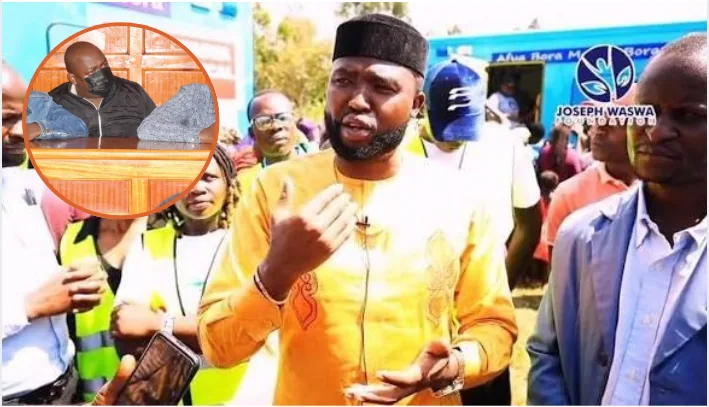
A Kenyan journalist has raised alarm over a series of disturbing messages he says he received after declining to help have an article about businessman Joseph Lendrix Waswa removed from the internet.
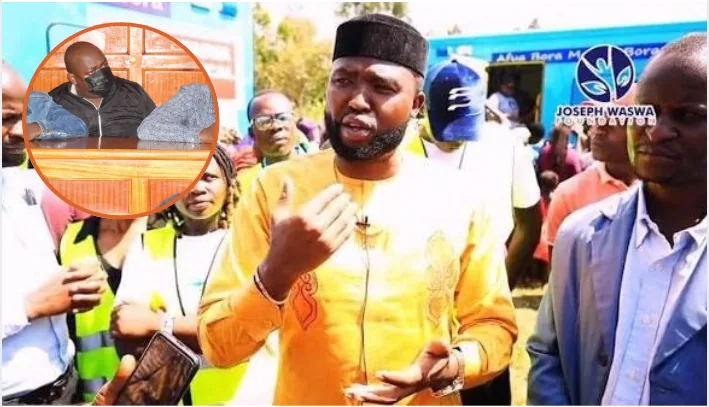
The journalist says he does not own or control the website that published the disputed article and repeatedly explained that he could not guarantee its removal. Screenshots reviewed for this story, however, show the dispute escalating into messages containing references to blood and warnings that the journalist would “see” what the sender would do.
The controversy centres on an article published by The Kenyan Daily Post concerning Waswa's private life and an alleged confrontation involving his wife at offices associated with Magnum Credit.
The article carried the headline: “Magnum Credit boss Joseph Waswa flies wife to a lavish vacation in Paris to cool things off after she stormed office and fought senior female staff member over their affair.”
The claims concerning Waswa's marriage and the alleged affair are not the focus of this report. The central issue here is the journalist's allegation that he was pressured over an article he says he neither wrote nor had the power to remove.
In one WhatsApp exchange, a message sent to the journalist reads:
“Omera abomanyi ngane nimekaa sana bila kuona Damu ya mtu.”
The most disturbing portion translates roughly to: “I have stayed a long time without seeing someone's blood.”
The journalist subsequently attempted to distance himself from the dispute, writing:
“Am out of this business. Thanks for your time.”
The response was:
“You can't be out.”
He then replied:
“I dont want blood in my hands.”
Rather than ending the exchange, the conversation continued with the journalist being urged to speak to the person behind the publication.
For the journalist, the combination of the blood reference and the refusal to accept his attempt to withdraw transformed what began as a dispute over an online story into a matter of personal safety.
The messages provided to this publication also include a separate SMS exchange.
One message states:
“Bro nitakupeleka mbio na Hio storie. Hutapenda.”
Loosely translated, this means: “Bro, I will deal with you over that story. You won't like it.”
Another message follows with:
“Wait you will see what I will do.”
Any individual message could potentially be dismissed as anger or bravado during a heated disagreement. The journalist says, however, that the messages became sufficiently concerning for him to preserve the conversations and document what he describes as threats.
The circumstances raise a fundamental question; why would a journalist be placed under pressure to remove an article from a publication he says he does not control?
The journalist says he works within the media industry and communicates with bloggers, publishers and other media personalities as part of his professional activities.
But having a relationship with a blogger does not make someone the owner of that blogger's website. Being able to contact a publisher does not give a journalist administrative authority over its content, nor does it mean the journalist can order a story to be deleted.
If Waswa believes the article published by The Kenyan Daily Post contains false or defamatory claims, he has lawful avenues through which he can challenge the publication, including seeking a correction, right of reply or legal remedy.
The journalist's position is straightforward; he cannot delete content that he does not control.
That distinction becomes particularly important because the controversial article was published by The Kenyan Daily Post rather than by the journalist now raising concerns.
The underlying claims about an alleged confrontation involving Waswa's wife and a female employee associated with Magnum Credit remain claims made by the original publisher and should be treated as such unless independently established.
Waswa's name, meanwhile, has appeared in Kenyan news reports and court proceedings involving serious allegations over the years. Those records must be distinguished carefully from convictions.
In September 2023, People Daily reported that Waswa had been ordered to appear in court in connection with investigations arising from a purported KSh1 billion fake-gold transaction. The publication reported that he was expected to answer a charge involving possession of forged US banknotes valued at approximately KSh93.7 million. People Daily report
The Star subsequently reported in October 2023 that several suspects had been charged following investigations into a fake-gold deal involving a Tunisian businessman, while Waswa was expected to appear separately over allegations involving forged banknotes. The Star report
However, later developments are equally important. In August 2025, prosecutors reportedly sought to withdraw charges against Waswa in a KSh400 million gold-fraud case after reviewing the evidence. Previous allegations should therefore not be presented as convictions.
Waswa's name also appears in the historical court record surrounding the fatal shooting of Mitch Barasa Kibiti at Club Etonia in Kimilili in August 2014.
A 2011 Kenya Gazette notice lists Joseph Lendrix Waswa alongside Club Etonia in Kimilili, establishing a documented connection between the businessman and the establishment.
The High Court case, Republic v Waswa, involved a murder charge over the death of Mitch Barasa Kibiti. Waswa pleaded not guilty.
Court records contain serious testimony from prosecution witnesses concerning the events surrounding the shooting. One witness testified that Waswa allegedly emerged during a disturbance, made words to the effect that he “must kill someone”, went towards his vehicle and returned holding what the witness believed was a pistol. The witness subsequently heard a gunshot and found his friend had been shot.
Another prosecution witness, a watchman near the club, described a confrontation outside the establishment and testified that Waswa warned those involved to stop or he would shoot. The witness later heard a gunshot and saw someone fall.
These were allegations and evidence presented by prosecution witnesses, not findings that Waswa committed the killing.
The case also contained forensic evidence that became central to the defence. A firearms examination found that Waswa's Ceska pistol did not match the spent cartridge recovered from the scene or the bullet extracted from the deceased.
The High Court ultimately identified significant gaps in the prosecution evidence, including the ballistic mismatch. The historical case therefore cannot accurately be presented as proof that Waswa killed the student.
What can be established from the record is that Waswa was prosecuted over the fatal shooting, witnesses gave serious testimony about his alleged conduct that night, and forensic evidence created a major evidential problem for the prosecution.
Historical reports also indicate that Club Etonia was attacked and torched following the killing, amid anger in Kimilili over the student's death.
That history is relevant only as background. It does not establish that Waswa was responsible for the present-day messages received by the journalist.
Waswa's public profile has also expanded beyond business.
The businessman has increasingly been associated with activities in Webuye West, including philanthropy, sporting events and community initiatives, as he positions himself for a possible parliamentary bid in the 2027 General Election.
That political ambition gives the latest controversy an additional public-interest dimension.
Anyone seeking elected office can expect greater scrutiny of their public conduct, relationships and response to criticism. But the existence of allegations or controversy should never be treated as proof of wrongdoing, just as criticism of a public figure does not remove that person's right to privacy or legal protection.
The central issue remains the messages.
The journalist says he attempted to withdraw from the dispute and was told:
“You can't be out.”
He says another message warned:
“Bro nitakupeleka mbio na Hio storie. Hutapenda.”
He then received:
“Wait you will see what I will do.”
Most concerningly, another communication referred to having stayed a long time without “seeing someone's blood.”
Those words warrant an explanation.
Waswa should have an opportunity to clarify whether he was directly involved in sending the messages, what the sender intended by the references to blood, and why the journalist was being pressured over a story published by another outlet.
The distinction is critical because a dispute over journalism has lawful remedies.
If a publication is inaccurate, the affected person can demand a correction. If a report is defamatory, legal action can be pursued. If important facts have been omitted, the affected person can provide evidence and seek a right of reply.
Those mechanisms exist precisely because journalism cannot function if disagreements are settled through intimidation.
Waswa has previously been the subject of intense media scrutiny. In 2019, police seized approximately KSh32.6 billion in counterfeit foreign and local currencies together with suspected fake gold from a residence in Ruiru. Business Daily reported that investigators linked the discovery to an investigation involving people suspected of impersonating then-President Uhuru Kenyatta in an attempt to obtain money from businessman Naushad Merali. Waswa was among those identified in reporting surrounding the investigation. Business Daily report
His name has also appeared in subsequent court proceedings.
In July 2026, The Star reported that Waswa and former Sports Cabinet Secretary Rashid Echesa were among defendants in a KSh250 million fraud and extortion case involving Kakamega Governor Fernandes Barasa. The report said a Kibera court gave Barasa a final opportunity to provide financial records requested by the defence. The allegations remain subject to determination by the court. The Star report on the case
Waswa's legal history has also reached Kenya's appellate courts.
In Joseph Lendrix Waswa v Republic, a case arising from the murder prosecution over the death of Mitch Barasa Kibiti, the appellate litigation dealt with questions surrounding the participation of lawyers representing the victim's family in criminal proceedings. Kenya Law judgment
Again, the appellate proceedings should not be misrepresented as a finding that Waswa was guilty of the underlying murder charge.
The broader point is that Waswa is a public figure whose affairs have repeatedly attracted media and judicial scrutiny.
That does not mean his private life is automatically public property.
During the WhatsApp exchange, the journalist reportedly told Waswa:
“You need to change such because you are a public figure.”
Waswa responded:
“It's my life men.”
He is entitled to that view. Public figures retain rights to privacy, and journalists have an obligation to distinguish legitimate public-interest reporting from unsupported or intrusive claims.
But when a public figure believes reporting has crossed the line, the answer is not intimidation.
The article about Waswa's wife may ultimately prove accurate, inaccurate or partly accurate. That is a separate matter that should be resolved through evidence and, where necessary, appropriate legal or media mechanisms.
The more immediate concern is whether a journalist was threatened because he could not make another publisher remove an article.
That is a serious allegation.
And because the journalist says he does not control the publication in question, the pressure placed on him appears, at minimum, to raise questions about whether the wrong person was being held responsible for content published elsewhere.
The journalist's account also raises wider concerns about press freedom.
Journalists, bloggers and media professionals must be able to communicate, investigate and publish without fearing personal retaliation from powerful individuals who dislike unfavourable coverage.
Likewise, people who believe they have been unfairly or unlawfully portrayed by the media must have the freedom to challenge those reports through lawful means.
Both principles can exist at the same time.
What cannot become normal is the use of references to blood, warnings and intimidation as a response to an unwanted headline.
The most important unanswered questions therefore concern the messages themselves.
Who sent them?
What exactly did the sender mean by saying they had stayed a long time without “seeing someone's blood”?
Why was the journalist told, “You can't be out,” after attempting to withdraw?
What was meant by, “Wait you will see what I will do”?
And why was a journalist who says he neither owns nor controls The Kenyan Daily Post being pressured to remove an article published by that outlet?
Waswa should be given an opportunity to answer those questions and provide his version of events.
But the screenshots, if authentic and accurately presented, are serious enough that they should not simply be dismissed.
A disagreement over an article should be settled by facts, corrections, editors, lawyers or courts—not threats.
If a story is false, challenge it.
If it is defamatory, seek legal redress.
If it is inaccurate, demand a correction.
But no journalist should have to fear for their safety because another publisher refuses to delete a story.