
Afya SACCO delegates have been told that no dividends or rebates will be declared for the financial year ended 31 December 2025, extending a suspension that also affected the previous 2024 cycle, a decision announced during a recent delegates meeting that has drawn attention to the institution’s financial position and governance record.
The Board informed members that the decision was not incidental but a structured outcome tied to regulatory requirements, liquidity constraints, and the need to strengthen institutional capital, framing the move as a protective step meant to stabilise the SACCO over the long term rather than distribute returns in the current cycle.
The communication comes at a time when Afya SACCO is already operating under sustained scrutiny from regulators and members, with questions lingering over governance systems, financial management decisions, and internal controls that have been flagged repeatedly since 2022.
No dividends decision triggers frustration among members
During the delegates meeting, leadership stated that withholding dividends and rebates was necessary to safeguard liquidity and reinforce capital buffers, a position that directly affects members who continue to contribute savings and hold shares within the SACCO structure.
The explanation presented to delegates centred on three main factors: regulatory requirements that govern SACCO financial conduct, liquidity constraints affecting operational flexibility, and a strategic push to strengthen institutional capital.
Some members in attendance expressed frustration over the decision, saying they continue to save and invest without clear returns.
“We are being told to remain patient every year, yet two financial cycles have gone without dividends. Members are asking where their money is going,” one delegate said.
“People are still subscribing and buying shares, but there is no clarity on returns. It feels like we are funding something we cannot see,” another member said.
“You cannot tell members to trust the system while the system keeps delaying what is due to them. Confidence is going down,” a third member said.
Governance and internal controls under renewed focus
The delegates meeting also placed governance and internal controls at the centre of discussion, with the Board acknowledging a period marked by heightened regulatory engagement and internal pressure.
SASRA and the Ministry responsible for cooperative oversight have maintained engagement with the institution over governance and financial management systems, while members have continued to raise concerns about operational transparency and decision-making structures.
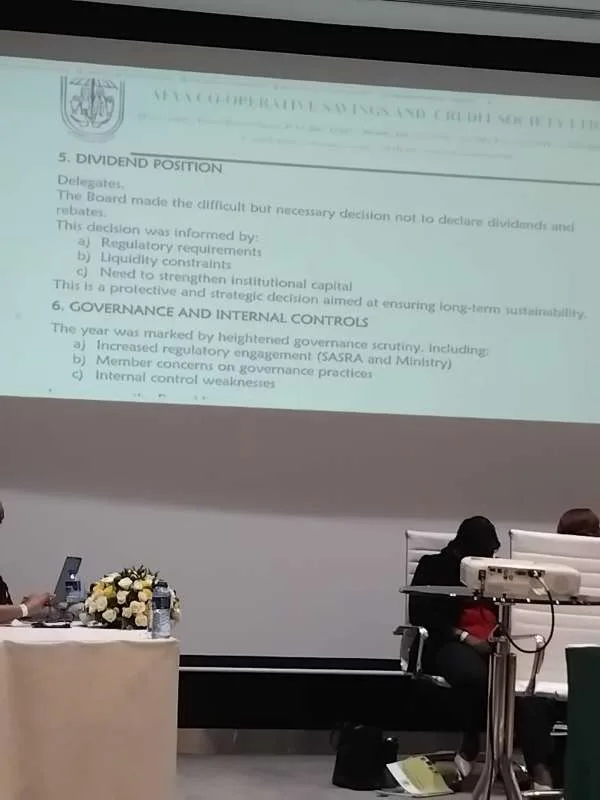
Internal control weaknesses were also referenced in the meeting, adding another layer to an already complex governance environment where oversight mechanisms have repeatedly come under examination.
“We are hearing about controls and reforms, but on the ground members only see delays, missing explanations, and unclear financial direction,” one long-serving member said.
Scandal background: regulatory probes, disputed figures, and member unrest
Afya SACCO has been linked to an ongoing governance and financial scandal that gained national attention in 2025, with regulators and members raising questions over irregular withdrawals, undocumented payments, and disputed cash transactions spanning multiple years.
Reporting tied regulatory inquiries to transactions between 2022 and 2024, with SASRA and the Co-operative Development office involved in examining financial flows and governance decisions within the SACCO structure.
At the centre of the inquiry are allegations of irregular withdrawals and undocumented payments, alongside concerns over allowances and cash handling processes that were not fully supported by documentation.
Regulators also moved to issue directives affecting operational controls, including closure of a cash office, suspension of certain allowances, and recovery of funds linked to former officials.
“People are not just angry about dividends. The deeper issue is trust. Members want to know what happened to the money over those years,” a member familiar with the discussions said.
Financial exposure estimates and disputed figures
The financial scale of the matter has been reported in varying ranges depending on source and stage of review.
Regulator-linked reporting has consistently pointed to more than KSh 550 million under inquiry in relation to irregular financial activity, while separate member-driven claims have placed broader alleged exposure between approximately KSh 2 billion and KSh 2.9 billion.
These higher figures remain contested and are not presented as final regulatory findings, reflecting ongoing divergence between member perceptions and formal investigative outcomes.
In parallel, Afya SACCO also recorded a write-off of KSh 361.6 million linked to failed investments in KUSCCO during its 2024 accounts, adding pressure to its balance sheet position and feeding into wider questions on investment decisions.
“Every meeting brings new numbers, but members do not see recovery or returns. That is what is hurting people most,” one delegate said.
Timeline of events leading to current pressure
The unfolding situation has developed over several years rather than a single incident.
In 2022, members first began raising concerns over financial conduct, with later reports pointing to early allegations tied to withdrawals and allowances recorded from February of that year.
Through 2024, the concerns persisted as irregular transactions were reported to have continued up to August, even as financial statements reflected major write-offs linked to external cooperative investments.
In May 2025, pressure from members escalated sharply, with ultimatums issued over alleged embezzlement claims and renewed scrutiny directed at leadership financial decisions.
By mid-2025, members had moved to remove the entire board during a heated annual general meeting, marking a turning point driven by deep dissatisfaction over governance direction and financial accountability.
In August 2025, SASRA formally launched a probe into alleged misappropriation exceeding KSh 550 million, focusing on undocumented withdrawals, inflated allowances, and unapproved payments.
By October 2025, the Commissioner for Co-operative Development ordered a formal inquiry into the SACCO’s by-laws, financial systems, and management conduct, extending oversight beyond internal governance structures into a broader institutional review.
In December 2025, criminal proceedings added a new layer to the matter when Evans Mung’ahu Kola, Patrick Kuya Lubako, and Mumina Mutinda Ing’ui were charged before the Milimani Law Courts over allegations of stealing more than KSh 40 million belonging to members’ contributions.

Court documents indicated the funds were allegedly siphoned through fictitious deposits and fraudulent withdrawals from Front Office Service Activity (FOSA) accounts between April 2021 and January 2025.
The three denied the charges, which included conspiracy to commit a felony, stealing, acquisition of proceeds of crime, and use of illegally acquired funds, and were released on bond pending further proceedings set for January 2026.
Members caught between contributions and uncertainty
Despite the governance pressure and financial uncertainty, members continue to contribute savings and hold shares within Afya SACCO, even as dividend payments remain suspended for at least two consecutive cycles.
The absence of payouts, combined with ongoing investigations, has placed members in a difficult position where trust in governance structures is being tested against expectations of returns and financial transparency.
“We are told to keep saving, but when it is time for returns, there is always a reason. It is becoming hard to understand the direction,” one frustrated member said.
“People are still joining the SACCO, but old members are now asking serious questions. Something has to change,” another member said.
Delegates at the recent meeting were told that the current decision to withhold dividends is part of a stabilisation strategy, though for many members the immediate impact is the continued absence of returns on their investments.
Regulatory pressure and internal reform expectations
The SACCO now operates under continued regulatory engagement, with SASRA maintaining oversight of financial and governance reforms, while cooperative authorities monitor compliance with legal and operational requirements.
Internal reforms are expected to focus on governance restructuring, financial controls, and restoration of member confidence, particularly as investigations into past transactions continue to shape perception of the institution.
“Reforms are welcome, but members want action, not just explanations. Confidence must be rebuilt through results,” a delegate said.