
A bitter and increasingly public falling-out between National Assembly Majority Leader Kimani Ichung’wah and Murang’a Governor Irungu Kang’ata spilled fully into the open on Sunday, May 3, 2026, with Ichung’wah launching a blistering personal attack on the governor hours after Kang’ata announced his exit from the United Democratic Alliance ahead of the 2027 general election, only for Kang’ata to respond not with a counter-attack but with a studied and pointed refusal to be drawn into personalised combat, a posture that in its own way landed harder than any rebuttal might have.
The immediate trigger for Ichung’wah’s offensive was Kang’ata’s public criticism of President William Ruto’s government, in which the governor said the administration had failed to deliver meaningful change for Kenyans, a statement that appears to have struck a particularly raw nerve within the President’s inner circle and that prompted a response from Ichung’wah that went well beyond the usual register of intra-coalition disagreement, crossing firmly into the territory of personal accusation and barely concealed threat.
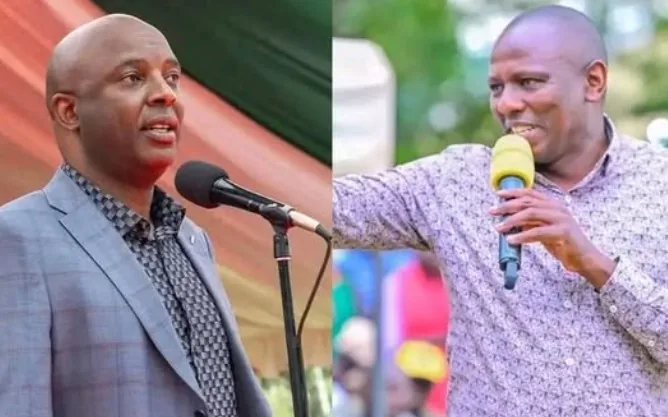
Ichung’wah, who represents Kikuyu Constituency and serves as the Leader of the Majority Party in the National Assembly, dismissed Kang’ata’s claims of political pressure as hypocritical, insisting that their recent exchange at Kenneth Matiba Hospital was nothing more than a candid confrontation of what he termed glaring inconsistencies in the governor’s political conduct.
He went further, dragging a controversial meeting in Lavington during the Rigathi Gachagua impeachment period into the public domain, alleging that it was Kang’ata himself who had exerted intense pressure at the time in pursuit of the Deputy President position that ultimately went to Kithure Kindiki, a claim the governor had not publicly addressed before Sunday and that Ichung’wah clearly calculated would complicate Kang’ata’s attempt to position himself as a principled victim of political bullying.
Ichung’wah also accused Kang’ata of invoking the name of former Deputy President Gachagua in political manoeuvres specifically designed to curry favour with the impeached former deputy president while simultaneously working to sideline rivals within the Mt. Kenya political field, a more precise and damaging charge than mere name-dropping, one that painted the governor as engaged in a calculated double game.
He warned Kang’ata to fight his own battles, stop hiding behind other people’s names to advance what he described as deceptive and self-serving politics, and issued what amounted to an unmistakable threat, hinting at undisclosed details from their past engagements touching on Murang’a county resources that he suggested it would not be in the governor’s interest to have aired publicly.
“I have chosen to respond publicly because you chose that route,” Ichung’wah declared, signalling that the dispute had moved decisively beyond the realm of private political disagreement and that he was prepared to keep escalating if Kang’ata continued on his current path.
Kang’ata, speaking to Citizen TV on Sunday, chose a different register entirely, one that conspicuously declined to meet Ichung’wah on the terrain of personal accusation.
He turned instead to the larger political picture, predicting outright electoral catastrophe for UDA in Murang’a if the party’s current trajectory is not corrected, and in doing so reframed the entire exchange as being not about a personal spat between two politicians but about a governing party making strategic errors that will cost it dearly in a vote-rich region it cannot afford to lose.
“I have seen how the politics is going on, and I think I am now convinced it will not end well for the UDA party, at least in my region,” Kang’ata said, adding that he had privately shared his concerns with President Ruto approximately a year ago in a meeting intended to align political strategy in the region, a conversation that produced no agreement and after which he chose to remain quiet, concentrating on his gubernatorial mandate, until the cumulative pressure of events made silence no longer tenable.
That pressure, he made clear, did not come only from party heavyweights but from his own supporters, whose expectations had been building and who had been pushing him toward a more defiant public stance long before he finally took one, a detail that establishes his announcement not as an impulsive reaction to Ichung’wah’s provocation but as the product of sustained pressure from his own political base.
“When I became a governor, my political strategy was to be quiet, to concentrate on my mandate,” he said. “It reaches a stage when the president is in Murang’a, you are put into a corner where you have to say something, you are being nudged to make a choice to announce your statement, and if you don’t, people start saying you are not a good person.”
He drew a direct line between UDA’s current difficulties in the region and the trajectory that destroyed Jubilee Party ahead of the 2022 general election, a comparison that will not have been lost on anyone in the President’s political circle, given that the collapse of Jubilee’s Mt. Kenya support base was among the defining features of that electoral cycle and a cautionary tale that UDA’s architects have always insisted they would not repeat.
On Ichung’wah specifically, Kang’ata was deliberate and disarming in equal measure, refusing to trade blows with a man he pointedly described as a friend while simultaneously leaving the door open to a version of events that would, if ever fully told, cast serious doubt on the accuracy of what the Majority Leader had placed in the public domain.
“I will not respond to Kimani Ichung’wah, who remains my friend.
This thing is not personal and I will not be drawn to personalization of politics and I know Kimani from where I sit; he remains a good friend,” Kang’ata said, before adding a remark that carried its own quiet but considerable weight.
“The full details of my supposed candidature to become DP after the impeachment, for now I do not intend to talk much about. I wish Kimani calls me in private, I will tell him the true story.”
That closing line, with its implication that the version of events Ichung’wah had placed in the public domain was incomplete at best and misleading at worst, was perhaps the sharpest thing Kang’ata said all day, delivered not as a threat but as an invitation, and all the more effective for the restraint in which it was wrapped.
Kang’ata clarified that he is not exiting UDA immediately, stating that he will remain in the party until 2027 and will make a formal announcement on his next political home in due course.
He has however made clear that the gubernatorial seat he won on a UDA ticket in 2022 will not be defended under the same banner, a decision he framed as a matter of principle rooted in what he described as the party’s drift toward political intolerance and the erosion of the democratic norms that he argued brought UDA to power in the first place.
The stakes of this falling-out extend well beyond two politicians trading accusations on a Sunday afternoon. Murang’a is part of a Mt. Kenya voting bloc that remains central to President Ruto’s 2027 numerical calculus, and Kang’ata’s exit, combined with his prediction of catastrophic UDA losses in the region, represents a direct challenge to the assumption that the President’s home turf remains consolidated behind him at a moment when former Deputy President Gachagua is actively working to fracture precisely that assumption through his Democracy for Citizens Party.
The exchange lays bare fractures within Mt. Kenya’s political establishment that are deepening with visible speed as the 2027 election approaches and the question of regional political alignment becomes impossible to defer any further.