
Kenya’s voter register has expanded by more than 2.6 million names following the conclusion of a dual-track registration drive, placing the Independent Electoral and Boundaries Commission (IEBC) on a strengthened footing ahead of the 2027 General Election.
Data released in the commission’s final status report on Thursday shows that 2,612,725 new voters were added through a combination of routine Continuous Voter Registration (CVR) and the large-scale Enhanced Continuous Voter Registration (ECVR) Phase I. The routine CVR process, conducted at IEBC offices between September 29, 2025 and April 2026, contributed 267,249 registrations, while the ECVR Phase I exercise, carried out between March 30 and April 28, 2026, accounted for 2,345,476 entries.
The month-long enhanced exercise formed the core of the registration effort, driving rapid expansion of the voter roll across all 290 constituencies and 1,450 wards. Registration points were extended beyond traditional IEBC offices to Huduma Centres, institutions of higher learning, and the commission’s Customer Experience Centre in Nairobi, widening access for eligible citizens across different regions.
Execution at that scale relied on extensive deployment of personnel and infrastructure, with 30,615 registration centres set up nationwide, supported by 12,520 trained officials and 5,390 Kenya Integrated Election Management System (KIEMS) kits. The operational model sustained high daily turnout, with weekly registration figures exceeding 500,000 after the initial rollout phase.
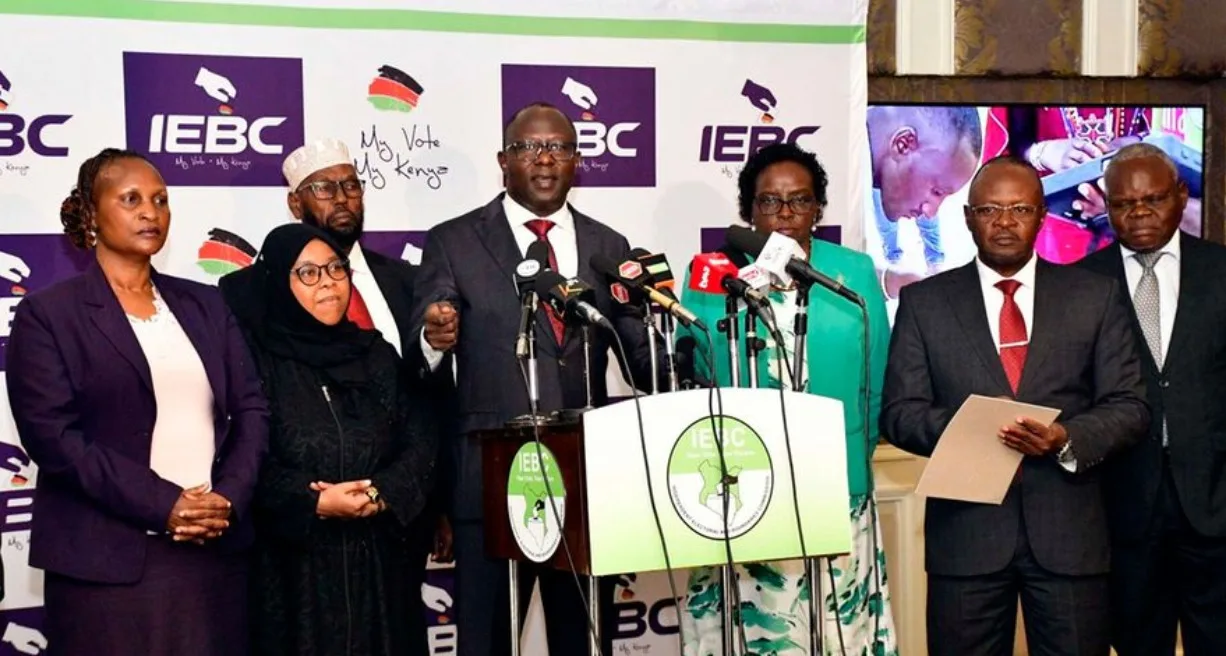
IEBC Chairperson Erastus Ethekon linked the outcome to public participation levels and institutional adjustments made in the lead-up to the exercise.
“This exercise demonstrates a strong national commitment to participate in the democratic process and signals a high level of readiness for the 2027 General Election,” he said.
Comparative figures show a marked shift from previous cycles. The 2016 mass registration phase recorded 1.45 million voters over a similar duration, while the 2021 exercise delivered about 1.5 million. The latest outcome approaches double those figures, pointing to a shift in execution capacity and uptake.
Ethekon pointed to operational changes as a key driver of the outcome, citing the adoption of a more flexible registration framework.
“The Enhanced Continuous Voter Registration approach has proven to be a more efficient, inclusive and responsive model that can be scaled nationally,” he said.
A central feature of the model was the “open kit” system, which allowed eligible voters to register at any location regardless of place of origin. According to the commission, this removed location-based restrictions that had previously limited participation, particularly among urban populations and mobile workers.
Targeted outreach also played a role, with universities, technical institutions, and Huduma Centres integrated into the rollout, drawing in young people and first-time voters who formed a large share of the newly registered electorate.
Operational planning was supported by data-driven systems and real-time monitoring tools. ID-based datasets and live tracking mechanisms enabled the commission to identify high-potential areas, adjust resource allocation, and respond to emerging issues during the exercise. Weekly public updates on registration progress were also maintained throughout the period.
Even with the gains recorded, uneven turnout remained evident across regions. Arid and semi-arid counties recorded lower numbers, linked to infrastructure gaps, long travel distances, and socio-economic barriers that limited access to registration points.
Logistical strain also emerged in transporting KIEMS kits across remote terrain, while localised security disruptions interfered with operations in some areas. At the same time, misinformation circulating online required sustained communication efforts to maintain clarity around the exercise.
Weather patterns added another layer of difficulty, with floods and drought conditions affecting access in certain regions, pointing to the need for climate-responsive planning in future registration cycles.
County-level data places Nairobi at the top with 276,886 new voters, followed by Kiambu at 128,859 and Nakuru at 102,207. Kakamega, Bungoma, and Machakos also recorded strong numbers, reflecting steady participation across urban and peri-urban regions.
Attention now shifts to verification and audit processes, which the commission says will be central to ensuring the credibility of the updated register. The next phase will involve biometric de-duplication, public verification of voter details, and an independent audit before final certification.
“This process includes biometric de-duplication, public verification of voter details, and an independent audit before certification,” Ethekon said, adding that maintaining momentum remains a priority.
“The gains realised provide a strong foundation for enhancing the integrity and inclusiveness of the Register of Voters, which remains central to delivering a free and credible election,” he added.
Continuous voter registration remains open at Huduma Centres and constituency offices, allowing those who did not take part in the mass exercise to still enlist ahead of the next electoral cycle.