
A deepening and highly complex crisis has enveloped businessman Mujtaba Jaffer and associated petroleum interests, as developments within Kenya fuel sector intersect directly with an intensifying high value financial dispute, producing a convergence of regulatory breakdown, opaque commercial structuring, and direct economic impact upon consumers across the country in a manner that continues to attract sustained institutional attention.
The Consumer Federation of Kenya has issued a forceful and detailed denunciation of One Petroleum Limited, a company led by Mohamed Hussein Jaffer, rejecting the firm defence regarding the MT Paloma fuel consignment and describing it as riddled with distortions, omissions, and misleading narratives that fail to withstand analytical examination when placed against documentary and operational evidence now circulating within both regulatory and investigative domains.
At the centre of the unfolding dispute stands One Petroleum Limited, a firm linked to Mohamed Hussein Jaffer and his son Mujtaba Jaffer alongside other directors, which COFEK accuses of misleading the Kenyan public while off specification fuel entered the domestic supply chain through mechanisms that appear to have operated within formal authorisation channels while simultaneously undermining the intended safeguards embedded within those same regulatory structures.
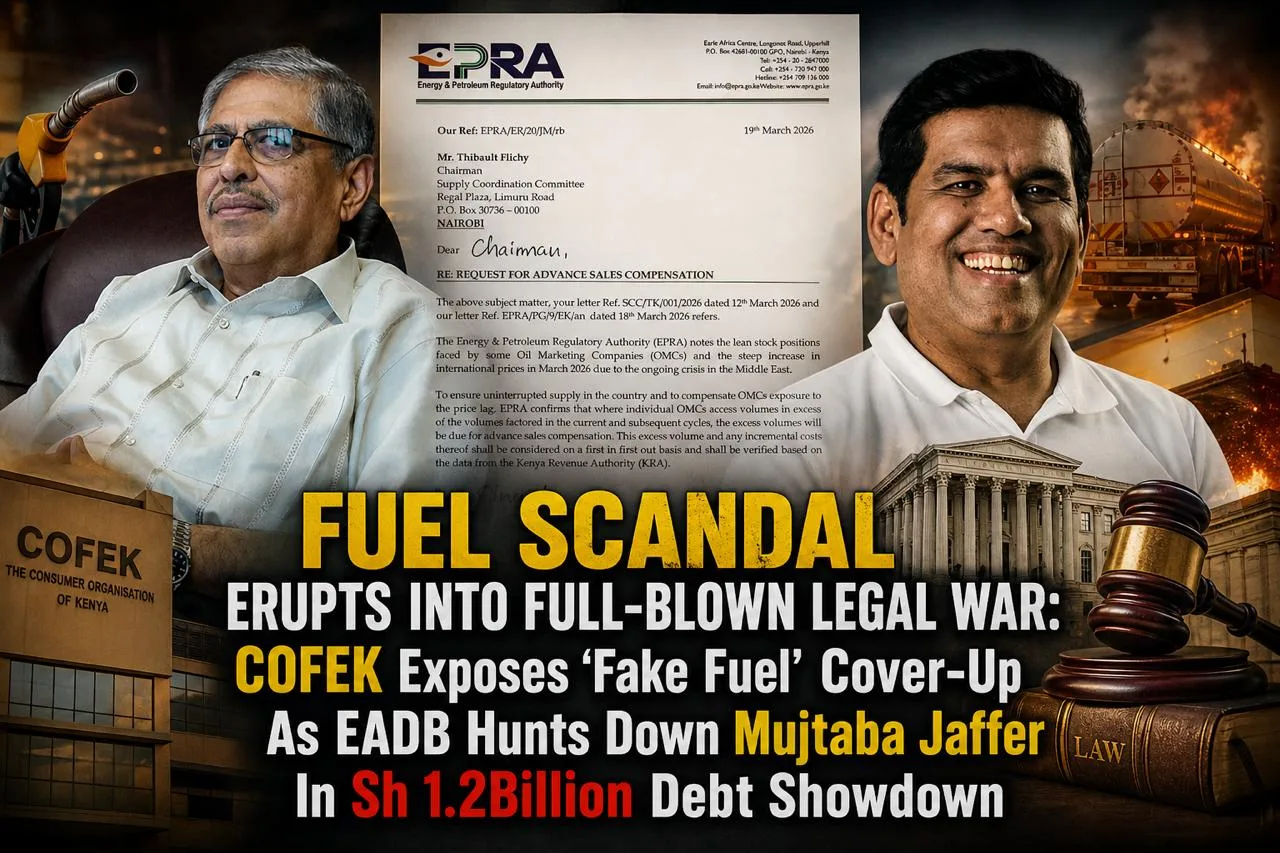
The organisation states that the company must assume full responsibility for what it terms a fake fuel crisis that has imposed extensive financial costs upon motorists through engine damage while also introducing measurable public health risk through the distribution of fuel containing elevated levels of sulphur, manganese, and benzene beyond the thresholds prescribed by the Kenya Bureau of Standards.
COFEK presents a detailed and methodical breakdown of the company public statements, setting out a sequence of findings that collectively construct a narrative of deliberate regulatory bypass under the cover of emergency procurement designation, a classification that the organisation describes as having been used to circumvent established safeguards under the Energy and Petroleum Regulatory Authority framework as well as applicable public procurement law.
Claims advanced by the company that the fuel cargo originated from British Petroleum and was destined for Angola have been identified for urgent international verification through vessel tracking systems, cargo ownership documentation, and maritime registry data, all of which now form part of the evidentiary matrix under examination by stakeholders seeking to establish the true commercial pathway of the MT Paloma consignment.
The acknowledgement that at least twenty percent of the fuel entered the Kenyan market prior to withdrawal is treated by COFEK as confirmation that contaminated product reached end users, thereby transforming the issue from a regulatory irregularity into a direct consumer harm scenario with measurable financial and mechanical consequences.
Reliance upon outdated fuel standards is characterised not as a legitimate defence but as an implicit admission that the product failed to meet current safety thresholds mandated within Kenya regulatory framework, thereby reinforcing the argument that the consignment could not lawfully have been introduced into the domestic market under ordinary compliance conditions.
The organisation further states that a waiver granted by the Ministry of Trade presents profound constitutional and legal questions, advancing the position that no administrative action can lawfully override statutory obligations relating to consumer protection or dilute fuel quality standards designed to safeguard public welfare under Article 46 of the Constitution.
At the same time, COFEK has directed sustained criticism toward the Energy and Petroleum Regulatory Authority over a compensation framework under which Oil Marketing Companies are set to receive approximately Ksh 11 per litre for price movements linked to the March 2026 Middle East crisis, a mechanism that the organisation describes as economically skewed and legally fragile within the context of existing statutory mandates.
According to COFEK, the framework operates as a transfer of private sector exposure into public financial burden without delivering corresponding relief to consumers or retailers, thereby establishing a precedent within which risk allocation is distorted in favour of industry actors while end users remain unprotected within the pricing structure.
The organisation further characterises the government to government fuel procurement arrangement as structurally compromised in its current execution, stating that the State absorbs exposure at both importation and distribution stages while consumers remain the ultimate bearers of cost without visibility into pricing formulation or supply chain integrity.
Directors under intense review
Attention has now shifted toward the leadership structure of One Petroleum Limited, with persons linked to its directorship encountering sustained public and institutional pressure as investigative focus expands beyond the transactional level into governance and decision making responsibility within the company.
Those associated with the company include Mujtaba Jaffer, Manoj Shah, and Reena Amritlal in her capacity as administrator of the estate of the late Amritlal Devani, and their involvement has arisen in connection with both the fuel dispute and a separate financial case that continues to advance within the judicial system.
Their names have emerged within parallel contexts that together construct a composite picture of commercial exposure extending beyond a single transaction into a wider network of financial obligations and corporate engagements.
EADB pursues Ksh 1.2 billion claim
In parallel proceedings, the East African Development Bank has intensified legal action against Mujtaba Jaffer and co defendants in relation to a loan valued at 9.9 million United States dollars, equivalent to approximately Ksh 1.2 billion, linked to Kenya Bus Services Mombasa Limited, thereby introducing a second major axis of legal exposure.
The bank maintains that Jaffer, together with Manoj Shah and Reena Amritlal, executed personal guarantees and bears joint and several liability for repayment, framing the obligation as a continuing security that remains enforceable until full settlement of all outstanding amounts.
It states that Jaffer played a direct role in instructing payments to CMC Motors for bus procurement under the financing arrangement and that the debt originating from a facility issued in 1998 remains outstanding within the bank financial records.
The defendants contest enforcement on the basis that the terms of the guarantee were altered without consent, advancing a legal argument that such variation invalidates enforceability under established principles governing contractual guarantees.
The matter remains before Justice Kizito Magare, with judgment scheduled for June 10, a date that carries potential implications for both financial liability and reputational standing within the context of the concurrent fuel sector developments.
A convergence of pressures
The intersection of the fuel dispute, regulatory reaction, and high value debt litigation has created a convergence of pressures around Jaffer and associated commercial networks, producing a scenario in which legal exposure, public reaction, and institutional inquiry are unfolding simultaneously across multiple domains.
With Senate review anticipated, expanding legal proceedings, and sustained public attention, the situation continues to evolve into a major corporate and regulatory controversy within Kenya economic landscape.
COFEK has set out its position in direct terms, calling for the recall of the EPRA compensation framework, enforcement of accountability upon One Petroleum Limited, and prioritisation of consumer protection within the governance of Kenya energy sector.
MT Paloma and the structure of the transaction
On March 27, 2026, the tanker MT Paloma docked at the Port of Mombasa at approximately 4.14 pm carrying 60,200.813 metric tonnes of premium motor spirit later confirmed to contain sulphur, manganese, and benzene levels above Kenya Bureau of Standards limits, thereby initiating the sequence of events that now forms the core of the controversy.
The cargo was dispatched by One Petroleum Limited, a Mombasa registered energy company whose principal beneficial owner is Mohamed Hussein Jaffer, thereby establishing the corporate origin point of the transaction chain under examination.
Kenya petroleum import framework operates under a government to government arrangement through which fuel is sourced from the United Arab Emirates and Saudi Arabia at negotiated sovereign rates designed to stabilise pricing and control supply chain entry points.
Under this framework, the comparable cost for premium motor spirit stands at approximately United States dollars 84 per metric tonne, equivalent to about Ksh 10,934, while documentation attributed to One Petroleum reflects an import cost of United States dollars 253.94 per metric tonne, equivalent to approximately Ksh 33,013.
The resale price to downstream buyers is recorded at Ksh 198,855 per metric tonne, producing an estimated total transaction value of about Ksh 12 billion across the full cargo volume, with an estimated gross margin of approximately Ksh 10 billion after accounting for import costs.
Energy Cabinet Secretary Opiyo Wandayi confirmed that a comparable consignment under the government framework would have cost about Ksh 8.4 billion, while the MT Paloma cargo was priced at about Ksh 11.8 billion.
Regulatory authorisations and waivers
The authorisation sequence commenced with a March 9 National Security Council Committee meeting convened at the Office of the President and chaired by Chief of Staff Felix Koskei in response to disruption of fuel supply linked to closure of the Strait of Hormuz.
On March 25, Petroleum Principal Secretary Mohamed Liban formally authorised One Petroleum Limited and Oryx Energies to import up to 66,000 tonnes each, exceeding the standard ceiling by ten percent, at a time when MT Paloma was already in transit toward Mombasa.
Correspondence directed to the Kenya Bureau of Standards acknowledged that ship to ship transfer methods meant that the cargo might not have undergone standard certification at the load port, effectively indicating that the fuel had been tested under standards applicable to a different destination market.
A waiver issued on March 28 permitted entry of fuel exceeding prescribed limits subject to conditions such as destination inspection and indemnity provisions, yet available information indicates that these conditions were not enforced prior to integration of the fuel into the domestic system.
Invoicing and tax position
Invoices associated with cargo reference KGC01 2026 are dated March 28, the same day as issuance of the waiver, and record completed sales transactions at Ksh 198,855 per metric tonne while discharge operations were still underway at the port.
Each invoice reflects zero percent value added tax, and on an estimated transaction value of Ksh 12 billion, the uncollected tax at sixteen percent amounts to approximately Ksh 1.91 billion, representing a substantial fiscal dimension within the overall transaction structure.
No public explanation has been provided regarding the absence of tax collection across the transaction chain, leaving open critical questions regarding administrative action within the tax authority.
Distribution into the national system
One Petroleum issued a public statement indicating that the cargo did not enter the domestic market following a withdrawal directive, while Kenya Pipeline Company confirmed that the fuel was blended with existing stocks and released to Oil Marketing Companies for nationwide distribution.
The discharge period between March 27 and March 29 coincided with the Easter holiday, a period characterised by elevated consumption patterns, thereby increasing the probability that the fuel was widely utilised before any corrective intervention could be implemented.
Official language referencing partial consumption of the consignment prior to withdrawal constitutes the closest acknowledgment that the product reached consumers within the national market.
The divergence between the company statement and pipeline confirmation is resolved through invoice records dated prior to both statements, which establish the sequence of events within the transaction chain.
Official action and resignations
On April 4, Petroleum Principal Secretary Mohamed Liban, Kenya Pipeline Company Managing Director Joe Sang, and EPRA Director General Daniel Kiptoo left office shortly after arrest by the Directorate of Criminal Investigations in connection with the importation process, while additional officials were subjected to questioning.
The simultaneous departure of three senior officials did not resolve accountability questions but instead shifted the locus of examination toward criminal investigation processes, which remain ongoing.
Ownership structure and financial flows
Corporate registry documentation identifies shareholders of One Petroleum Limited as Mohamed Jaffer, Mujtaba Jaffer, Ali Abbas Jaffer, and Mohamed Husein Jaffer, with Mbaraki Holdings Limited of Mauritius holding 41,098 ordinary shares.
The presence of an offshore holding entity forms part of the financial architecture associated with the transaction and invites examination of cross border financial flows linked to cargo KGC01 2026.
What Remains Unanswered
The departure of MT Paloma from Mombasa on March 30, 2026 marked the end of the physical shipment yet did not resolve the questions generated by its cargo, pricing structure, tax treatment, and distribution pathway within Kenya petroleum system.
The invoices dated March 28, the zero tax entries, the pricing differential, and the integration of the fuel into the national pipeline together form the evidentiary foundation that now requires examination through parliamentary and judicial processes.
The convergence of regulatory action, commercial conduct, and financial litigation places this matter among the most consequential corporate controversies within Kenya in recent years, with outcomes that will influence governance within both the energy sector and financial system for years to come.